Do Not Underestimate Teams from Africa – They Are Ready to Create Surprises in the 2026 World Cup
When talking about the World Cup, many people often picture the dominant teams from Europe or South America. However, in recent years, “teams from Africa” have proven that they are not just participants – they are a group capable of “changing the balance of the game”.
The term surprises in the World Cup has often been associated with African teams, and this is no coincidence. They possess elements that many top teams find difficult to handle, whether it be speed, physical strength, or the courage to play without being intimidated by reputation.
The 2026 World Cup will be another stage where the 10 African nations – Morocco, Egypt, Senegal, Algeria, Ghana, South Africa, Ivory Coast, DR Congo, Tunisia, and Cape Verde – come to challenge their own limits.
The key questions are:
- Which teams have a real chance of going far?
- Who are the “dark horses”?
- And which team represents a golden opportunity for bettors on V9Bet?
This article will take you through an in-depth analysis of every team, not just a surface-level look.
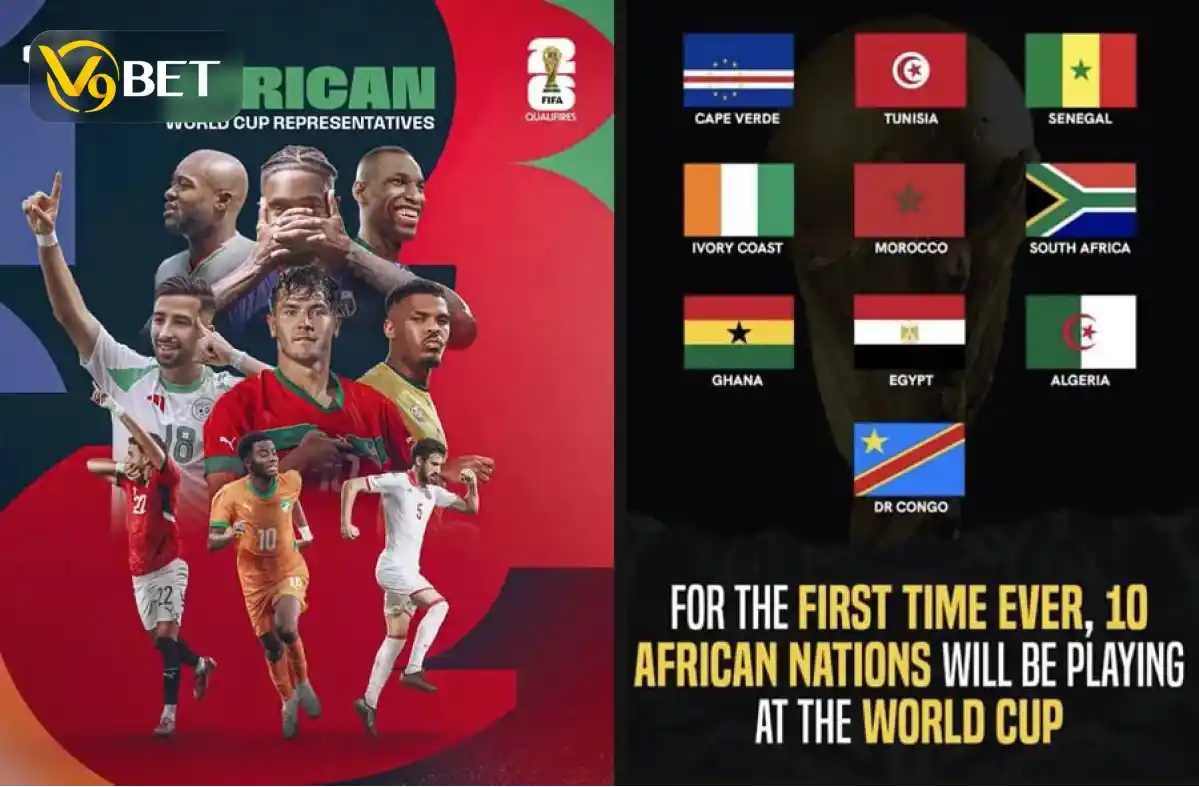
10 African nations ready to compete in the 2026 FIFA World Cup
Overview of Modern African Teams Ready to Create Surprises in the World Cup
The old perception of African teams was that they relied on raw power and individual ability but lacked system and tactical discipline. However, over the past 10 years, this view has clearly changed.
Many African players have gained opportunities in top European leagues, allowing them to learn more structured playing systems. This has enabled national teams to develop to a level closer to the leading sides.
What is particularly interesting is the combination of “natural rawness” and “organised systems”, which makes African teams one of the hardest groups to read in the World Cup.
That is why the term surprises in the World Cup so often comes from this group of teams.
The Growth of Players on the European Stage
African players are no longer just role players in European teams – they have become key players for many clubs. This has elevated their game understanding and confidence on the big stage.
A Playing Style Different from Others
The speed and physical strength of African teams allow them to play at a rhythm that European teams are not used to, causing significant problems in knockout matches.
The Top Contenders from Africa with a Real Chance to Go Far and Create Surprises in the World Cup
Among the 10 African teams likely to compete in the 2026 World Cup, the most intriguing group are those not just there for experience – they have the quality to get past the group stage and advance deep into the tournament. Morocco, Senegal, and Ivory Coast stand out as the most complete teams in terms of player quality, high-level experience, and ability to handle top opponents.
What makes this group dangerous is that they no longer rely solely on physicality or speed like the old stereotype of African football. Their systems have evolved significantly. Many players compete in top European leagues, face high pressure regularly, and understand modern tactics better. As they enter the World Cup, they can no longer be overlooked.
When talking about the potential to create surprises in the World Cup, this group has the highest probability. They can compete with top teams both physically and tactically. The key is consistency – if these teams maintain their standards throughout the tournament, they are not merely aiming to “qualify from the group”, but can realistically push for the quarter-finals or even further.
Morocco – Africa’s Number One Contender, Already Proven
Morocco must be placed among Africa’s very top contenders without question. They are not just a team with potential on paper – they have already proven they can handle world-class opposition. Morocco’s strengths lie in the balance between a solid defence, rapid counter-attacks, and strong mental resilience in big games.
What sets Morocco apart from many African teams is “tactical discipline”. They do not play an open, end-to-end game unnecessarily. They know when to defend, when to push the tempo, and when to attack. This is a crucial quality in tournament football, because the teams that go far are not necessarily the prettiest but those that know how to survive difficult matches.
Another interesting point is that Morocco have many players based in European leagues, giving them high-level game understanding. They do not get nervous on the big stage and are not afraid of top teams. Combined with the confidence from their recent World Cup performances, Morocco are well-positioned to produce big results again.
For bettors on V9Bet, Morocco is a particularly interesting team to analyse. Their odds may not be as highly rated as those of the giants from Europe or South America, but their actual quality on the pitch is closer than many think. If they face ball-dominant opponents who lack finishing sharpness, Morocco could offer very high value as a betting option.
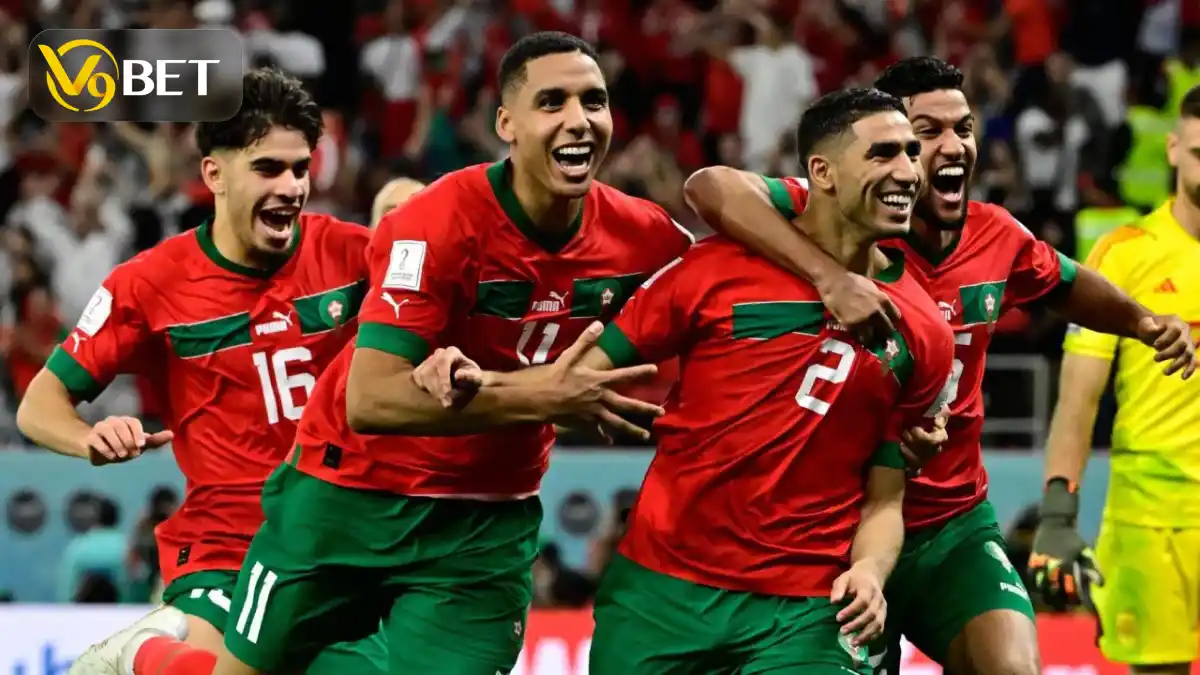
Morocco is the country with the best chance
Senegal and Ivory Coast – Two High-Class Teams with the Quality to Challenge Top Sides
Senegal and Ivory Coast are two teams with distinct identities, but they share one key characteristic: “top-quality players”. Both have players who have competed in major European leagues, have club-level experience, and are accustomed to intense competition. They are not teams that come to the World Cup afraid of anyone.
Senegal excel in physical strength, robustness in tackles, and the speed of their transitions from defence to attack. They can make opponents uncomfortable by not giving away space easily and having players who are strong in one-on-one duels. If Senegal can maintain their defensive concentration and become sharper in the final third, they have enough potential to reach the later rounds.
Ivory Coast, on the other hand, have a slightly different profile. This team often has more variety in attack, with players who can create chances in tight spaces, launch quick counter-attacks, and change the game through individual moments. Ivory Coast’s strength is adaptability – they can play both a physical game and an open, attacking game.
What both teams need to watch out for is consistency. Many African sides have periods of playing very well but lose focus at crucial moments. If Senegal and Ivory Coast can fix this, they will become very dangerous teams in the 2026 World Cup.
From a betting perspective, both teams are well-suited for markets such as total goals, handicaps, or live betting. Their games often see rapid momentum shifts – if you can read the moments correctly, you can use this information to find profitable angles on V9Bet.
Second-Tier Teams Ready to Cause a Stir at the 2026 World Cup
Beyond the clear frontrunners, there is another group that may not receive as much attention in the mainstream media but have the ability to “change the game” in the right circumstances – Egypt, Algeria, and Ghana.
These teams share a common trait: they are not perfect in every aspect, but they have “specific strengths” that can genuinely cause problems for top sides, especially when matches reach high-stakes phases like the knockout rounds.
What makes this group interesting in the context of surprises in the World Cup is that they often play above expectations in big games because they are not weighed down by pressure. They can fully utilise their strengths, unlike the favourites who carry heavy expectations.
Egypt and Algeria – Teams That Control Tempo Well and Play Systematically
Egypt and Algeria stand out for their ability to “control the game” – a departure from the stereotype of African teams relying solely on speed. Both can possess the ball, set the rhythm, and manage the tempo in an organised manner.
Egypt’s strength lies in composure and game understanding. Many of their players have high-level experience, enabling them to handle pressure well. They may not play flashy attacking football, but they excel at “choosing the right moments”, which is critical in the World Cup.
Meanwhile, Algeria have become more balanced recently. Their attack and defence are more connected, their movement is more structured, and they can create chances through passing combinations, not just individual brilliance.
However, both teams need to improve their decisiveness in the final third. At this level, chances are limited, and the team that is sharper in execution will have the advantage.
If Egypt or Algeria can sharpen their cutting edge just a little more, they will not be just underdogs – they can become “major variables” that cause upsets in the tournament.
Ghana – Youth, Speed, and Courage That Make the Difference
Ghana are clearly different from Egypt and Algeria. They play a high‑tempo, high‑energy game and are ready to engage in open exchanges whenever they see an opportunity.
What makes Ghana interesting is the “freshness of the team”. Many of their players are at an age where they are developing, they play with courage, and they are not afraid of big teams – a crucial mindset in the World Cup.
Ghana’s matches often feature rapid swings – they can transition from defence to attack in an instant and exploit transition moments well. This can punish teams that set up slowly or play too cautiously.
However, Ghana’s challenge is “consistency”. Their high‑energy style can lead to fluctuations in form, and their decision‑making in key moments still needs improvement.
The Dark Horses from Africa Who Could Turn the Tournament Upside Down
Beyond the favourites and second‑tier teams, there is another group that should not be overlooked – the “dark horses”. They are often major factors at the World Cup because they are not on the radar of bigger teams and have a habit of exceeding expectations.
For the 2026 World Cup, this group includes South Africa, DR Congo, Tunisia, and Cape Verde. Each team has different strengths, but they share one thing: “the readiness to play above their potential in big matches”.
These are the teams that can create surprises in the World Cup when no one is expecting it. They are not burdened by expectations and can play their natural game to the fullest.
South Africa and DR Congo – Power, Aggression, and Unpredictability
South Africa have a certain level of balance. While they do not have a large number of superstar players, they play with game understanding and more organised movement in recent times.
What is interesting is that this team can “play according to the match situation” well – defending with discipline when needed and speeding up the attack when the opportunity arises.
DR Congo, on the other hand, are raw and powerful. They play with intensity and have good one‑on‑one ability, which creates problems for teams that rely solely on tactics.
The danger of these two teams lies in their “unpredictability”. They can change the shape of the game quickly and are not tied down to any single style.
Tunisia and Cape Verde – Disciplined Teams That Patiently Wait for Their Moment
Tunisia’s strength is “defensive discipline”. They can organise well and slow down the opponent’s game, which is crucial in World Cup football.
Tunisia’s play may not be flashy, but it is effective – especially in matches where the result is more important than beauty.
Cape Verde are another interesting team. Though not widely known, they have shown clear development and can play in a more systematic way.
Cape Verde’s strength is patience. They do not hurry and wait for the right moment to attack, which can cause difficulties for overconfident opponents.
Read more: 9 Asian Teams and Their Chance of Reaching the Semi‑Finals in World Cup 2026
Analysing African Teams’ Prospects for Deep Runs in the 2026 World Cup
Looking at all 10 teams as a whole, it is clear that African football is no longer where it used to be. It is developing to a level where it can genuinely compete with the top nations.
However, reaching the later stages of the World Cup depends not only on team quality but also on other factors: the draw, form during the tournament, and the ability to handle pressure.
The teams with the best chance of going far are those that can “maintain balance” – both defensively and offensively – while staying composed in critical moments.
The Teams with the Best Chance of a Strong Performance
Overall, Morocco still has the highest chance, followed by Senegal and Ivory Coast.
These teams have complete attributes and the experience to handle big games.
The Chance of an Upset from the Underdogs
Even though the favourites appear superior, the World Cup is full of unexpected events.
Teams like Ghana or Algeria may need just a few moments to change a result and create surprises in the World Cup instantly.
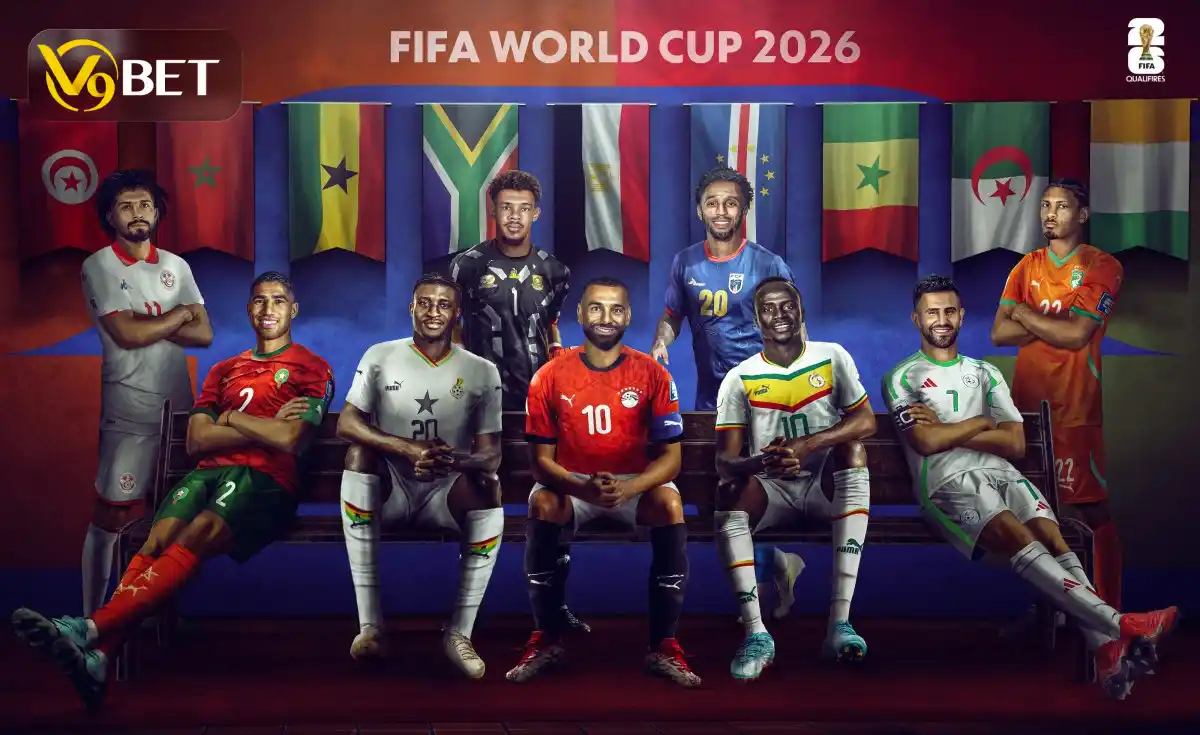
The key players of each team
Bettor’s Perspective – Profit Opportunities from African Teams on V9Bet
For bettors, the World Cup is a time of greatest value – especially when African teams are often undervalued relative to their real quality.
Many times, the odds for these teams offer worthwhile returns, provided you analyse the matches correctly.
- Betting on underdogs with reason: Choosing an African team should not be a mere “gamble”. It should be based on data such as playing style and the opponent. In some matches, an African team may have tactical advantages even if they are not the bigger name.
- Reading the game to find value: Looking only at team names is not enough. You must understand the flow of the game and the right moments to bet. This is what allows you to generate real long‑term profit.
Conclusion
The 2026 World Cup will not just be a stage for the giants – it will be where African teams play a more significant role than ever before.
Among all 10 teams, there are favourites, second‑tier sides, and dark horses – all capable of creating changes in the tournament.
The term “surprises in the World Cup” may no longer be just a phrase; it is becoming a “reality” that will happen again. For football fans, this is excitement. For bettors, this is opportunity.
If you can read the game, analyse the teams, and choose your moments accurately, African teams may not just be an alternative – they could be the “key to making profits” on V9Bet.